Zephyr UFS Driver Implementation
This page provides details on the implementation of the UFS Zephyr driver.
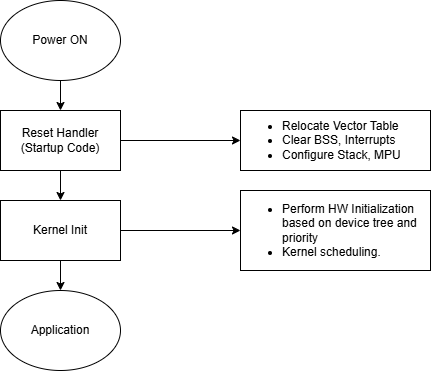
Zephyr - Boot up Process (Arm Cortex-R5 processor)
Zephyr Project - Directory Structure
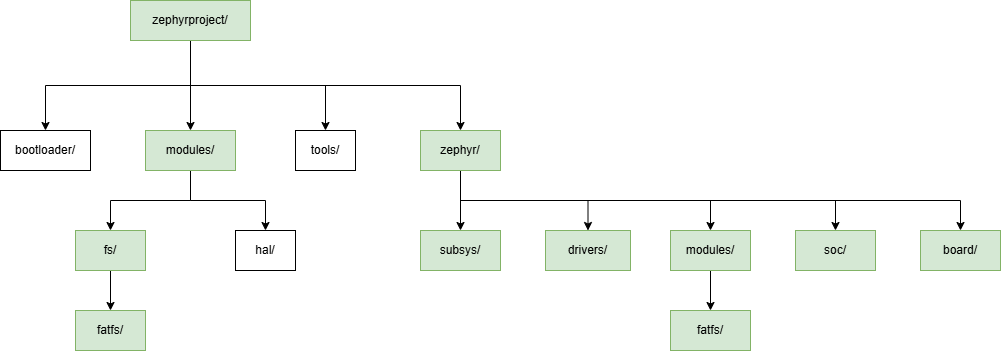
Top-level directory structure of a zephyrproject/ tree.
Zephyr - Subsystem Layer (Generic Driver Stack)

Zephyr generic subsystem layer.
Zephyr - Driver Layer (Vendor Specific Drivers)
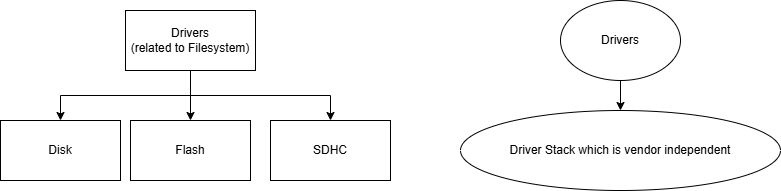
Zephyr vendor-independent driver layer.
Zephyr - UFS Driver (Proposed Directory Structure)
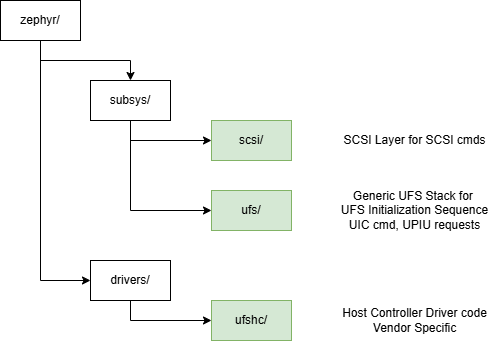
Zephyr - UFS Driver Device Tree
Ufs Node
ufs0: ufs@f10b0000 {
    compatible = "amd,versal2-ufshc";
    status = "disabled";
    reg =   <0xf10b0000 0x10000>,
            <0xf1060000 0x2000>,
            <0xf1250000 0x100>,
            <0xf1260000 0x100>;
    interrupts = <GIC_SPI 234 IRQ_TYPE_LEVEL IRQ_DEFAULT_PRIORITY>;
    clocks = <&ufs_core_clk>;
    clock-names = "core_clk";
};
amd,versal2-ufshc.yaml
# Copyright (c) 2024 Advanced Micro Devices, Inc.
# SPDX-License-Identifier: Apache-2.0

description: |
  Amd Versal Gen2 UFS Host Controller.

  Example usage:
      ufs@f10b0000 {
        compatible = "amd,versal2-ufs";
        reg = <0xf10b0000 0x1000>;
        interrupts = <GIC_SPI 234 IRQ_TYPE_LEVEL_HIGH>;
        clocks = <&ufs_core_clk>;
        clock-names = "core_clk";
        freq-table-hz = <0 0>;
        resets = <&scmi_reset 4>, <&scmi_reset 35>;
        reset-names = "ufshc-rst", "ufsphy-rst";
    };

compatible: "amd,versal2-ufshc"

include: [ufs-common.yaml, reset-device.yaml]

properties:
  clocks:
    required: true
    description: The list of clocks used by the UFS Host Controller.

  clock-names:
    required: true
    description: core_clk - Clock for the core logic

  interrupts:
    required: true
    description: Interrupts used by the UFS Host Controller.

  reg:
    required: true
    description: |
      - Host Controller Base address
      - IOU(Input-Output Unit) SLCR(System-Level Control Register)
      - EFUSE Cache register
      - UFS CRP(Clock reset Power) register

  resets:
    description: Reset control for both UFS Host Controller and PHY.

  reset-names:
    description: |
      - "ufshc-rst" - Reset signal for the UFS Host Controller
      - "ufsphy-rst" - Reset signal for the UFS PHY
Ufs Disk Node
ufs_disk0 {
    compatible = "zephyr,ufs-disk";
    lun = <0>;
    disk-name = "UFS";
    status = "okay";
};
Zephyr - UFS Driver Kconfig
CONFIG_AMD_VERSAL2_UFSHC — AMD Versal2 UFS Driver
CONFIG_UFSHC - UFS Driver
CONFIG_UFS_STACK - UFS Subsystem Stack
CONFIG_SCSI - SCSI Subsystem Stack
CONFIG_DYNAMIC_INTERRUPTS - Runtime interrupt configure
CONFIG_EVENTS - Posting ISR Events
CONFIG_HEAP_MEM_POOL_SIZE - For Heap Memory Allocation
CONFIG_CACHE_MANAGEMENT - For cached related operations
SCSI Layer
<subsys><scsi><src>
/* SCSI subsys file */


/**
 * struct scsi_cmd - information about a SCSI command to be processed
 * @cmd:     Command descriptor block (CDB)
 * @lun:     Target LUN (Logical Unit Number)
 * @cmdlen:  Length of the command
 * @datalen: Total length of data to be transferred
 * @pdata:   Pointer to data to be transferred
 * @dma_dir: Direction of data transfer (e.g., read/write)
 */
struct scsi_cmd {
    uint8_t cmd[MAX_CDB_SIZE];
    uint8_t lun;
    uint8_t cmdlen;
    uint64_t datalen;
    uint8_t *pdata;
    uint8_t dma_dir;
} __packed;

/**
 * struct scsi_host_info - Information about a SCSI host controller
 * @sdevices: List of connected SCSI devices
 * @ops:      Pointer to the SCSI operations structure
 * @hostdata: Pointer to host-specific data
 * @parent:   Parent device associated with the host
 */
struct scsi_host_info {
    sys_slist_t sdevices;
    const struct scsi_ops *ops;
    void *hostdata;
    struct device *parent;
};

/**
 * struct scsi_device - Information about a SCSI device
 * @node:        Node in the list of SCSI devices
 * @host:        Pointer to the associated SCSI host controller
 * @lun:         LUN ID for the device
 * @sector_size: Size of sectors in bytes
 * @capacity:    Total capacity of the device in blocks
 */
struct scsi_device {
    sys_snode_t node;
    struct scsi_host_info *host;
    uint8_t lun;
    uint32_t sector_size;
    uint32_t capacity;
};

/**
 * struct scsi_ops - Operations for managing SCSI commands
 *
 * @exec: Function to execute a SCSI command
 */
struct scsi_ops {
    /**
     * exec() - Execute a SCSI command
     *
     * @sdev:   SCSI device handle
     * @cmd:    SCSI command to execute
     *
     * @return: 0 on success, negative value on error
     */
    int32_t (*exec)(struct scsi_device *sdev, struct scsi_cmd *cmd);
};

/**
 * struct sg_io_req - Structure to represent a SCSI Generic (SG) I/O request
 * @protocol:         SCSI protocol type
 * @subprotocol:      Sub-protocol type (0 for SCSI command, 1 for SCSI transport)
 * @request:          Pointer to the SCSI CDB or transport layer request
 * @request_len:      Length of the request in bytes
 * @response:         Pointer to the response buffer
 * @max_response_len: Maximum length of the response buffer
 * @dxfer_dir:        Data transfer direction
 * @dxfer_len:        Length of the data to transfer
 * @dxferp:           Pointer to the data to be transferred
 */
struct sg_io_req {
    uint32_t protocol;
    uint32_t subprotocol;
    void *request;
    uint32_t request_len;
    void *response;
    uint32_t max_response_len;
    int32_t dxfer_dir;
    uint32_t dxfer_len;
    void *dxferp;
};

/* Public APIs exposed from SCSI layer */
/**
 * scsi_ioctl - Perform an IOCTL operation on a SCSI device
 *
 * @sdev: Pointer to the SCSI device
 * @cmd:  IOCTL command
 * @arg:  Arguments for the IOCTL command
 *
 * @return: 0 on success, negative value on error
 */
int32_t scsi_ioctl(struct scsi_device *sdev, int32_t cmd, void *arg);

/**
 * scsi_host_alloc - Allocate memory for a SCSI host controller
 *
 * @sops: Pointer to the SCSI operations structure
 *
 * @return: Pointer to the allocated scsi_host_info structure, or NULL on failure
 */
struct scsi_host_info *scsi_host_alloc(const struct scsi_ops *sops);
UFS Subsys Layer
To support UFS Bare-metal driver fnctionality in Zephyr OS
Host Controller Initialization
UIC Cmd, UTP Transfer Requests UPIU
<subsys><ufs><src>
/* UFS Subsys file */

/**
 * struct ufs_host_controller - UFS host controller private structure
 * @dev: Pointer to the driver device handle.
 * @mmio_base: Base address for the UFSHCI memory-mapped I/O registers.
 * @is_initialized: Flag indicating if the host controller has been initialized.
 * @irq: IRQ number for the UFS host controller.
 * @is_cache_coherent: Flag indicating whether the UFS controller supports cache coherency.
 * @ucdl_base_addr: Pointer to the UFS Command Descriptor base address.
 * @utrdl_base_addr: Pointer to the UTP Transfer Request Descriptor base address.
 * @xfer_req_depth: Maximum depth of the Transfer Request Queue supported by the controller.
 * @outstanding_xfer_reqs: Bitfield representing outstanding transfer requests.
 * @irq_event: Event object used to signal interrupt handling.
 * @ufs_lock: Mutex to synchronize access to UFS driver resources.
 * @dev_info: Structure holding information about the UFS device.
 * @host: Pointer to the SCSI host structure associated with the UFS controller.
 */
struct ufs_host_controller {
    struct device *dev;
    mem_addr_t mmio_base;
    bool is_initialized;
    uint32_t irq;
    uint8_t is_cache_coherent;
    struct ufshc_xfer_cmd_desc *ucdl_base_addr;
    struct ufshc_xfer_req_desc *utrdl_base_addr;
    uint32_t xfer_req_depth;
    uint32_t outstanding_xfer_reqs;
    struct k_event irq_event;
    struct k_mutex ufs_lock;
    struct ufs_dev_info dev_info;
    struct scsi_host_info *host;
};

/**
 * struct ufs_qry_ioctl_req - UFS IOCTL request
 * @ioctl_id: IOCTL identifier for the request
 * @attr: UFS attribute query data
 * @flag: UFS flag query data
 * @desc: UFS descriptor query data
 *
 * This structure holds data for different types of UFS query IOCTL requests,
 * including attribute, flag, and descriptor queries.
 */
struct ufs_qry_ioctl_req {
    uint32_t ioctl_id;
    union {
        struct ufs_qry_ioctl_attr attr;
        struct ufs_qry_ioctl_flag flag;
        struct ufs_qry_ioctl_desc desc;
    };
};

/**
 * struct ufs_sg_req - UFS SCSI Generic (SG) request
 * @msgcode: Message code for the request
 * @req_qry_ioctl: Pointer to the UFS query IOCTL request data
 *
 * This structure is used for representing SCSI Generic requests,
 * querying UFS attributes, flags, or descriptors.
 */
struct ufs_sg_req {
    int32_t msgcode;
    struct ufs_qry_ioctl_req *req_qry_ioctl;
};


/* Public APIs exposed from UFS Layer */
/**
 * ufs_init - Initialize the UFS host controller
 * @ufshc_dev: Pointer to the device structure for the UFS host controller
 * @ufshc: Pointer to the UFS host controller structure that will be initialized
 *
 * Return: 0 on success, negative error code on failure
 */
int32_t ufs_init(const struct device *ufshc_dev, struct ufs_host_controller ufshc);

/
 * ufs_sg_request - Handle a SCSI Generic (SG) request for UFS
 * @ufshc: Pointer to the UFS host controller structure
 * @arg: Argument for the request, which could be a UFS query or other data
 *
 * Return: 0 on success, negative error code on failure
 */
int32_t ufs_sg_request(struct ufs_host_controller *ufshc, void *arg);
UFS Driver Layer
Vendor Specific Driver API Implementation
Device Tree Instantiation
driver.h
/* Driver APIs which are hooked for UFS host controller */

/**
 * @brief UFS Host Controller (UFSHC) Driver API interface
 *
 * This structure defines the set of functions that must be implemented by the
 * UFS Host Controller driver for PHY initialization and link startup notifications.
 */
__subsystem struct ufshc_driver_api {
    /**
     * @brief PHY initialization for the UFS Host Controller.
     *
     * This function is called to initialize the PHY layer of the UFS Host Controller.
     *
     * @param dev The device pointer to the UFS Host Controller device.
     *
     * @return 0 on success, negative errno value on failure.
     *         -ETIMEDOUT: command timed out during execution.
     *         -ENOTSUP: host controller does not support this operation.
     *         -EIO: I/O error.
     */
    int32_t (*phy_initialization)(const struct device *dev);

    /**
     * @brief Link startup notification for UFS Host Controller.
     *
     * This function notifies the host controller about the link startup status.
     *
     * @param dev The device pointer to the UFS Host Controller device.
     * @param status The status of the link startup, either PRE or POST.
     *
     * @return 0 on success, negative errno value on failure.
     *         -ETIMEDOUT: command timed out during execution.
     *         -ENOTSUP: host controller does not support this operation.
     *         -EIO: I/O error.
     */
    int32_t (*link_startup_notify)(const struct device *dev, uint8_t status);
};
driver.src
#define DT_DRV_COMPAT amd_versal2_ufshc

/**
 * struct ufshc_versal2_config - Configuration for the Versal2 UFS Host Controller.
 * @mmio_base: Base address for the UFS controller memory-mapped I/O.
 * @core_clk_rate: UFS core clock rate in Hz.
 * @irq_id: IRQ line for the UFS controller interrupt.
 * @reg_iou_slcr: IOU SLCR register address for UFS configuration.
 * @reg_efuse_cache: eFuse cache register address.
 * @reg_ufs_crp: UFS CRP register address.
 */
struct ufshc_versal2_config {
    mem_addr_t mmio_base;
    uint32_t core_clk_rate;
    uint32_t irq_id;
    mem_addr_t reg_iou_slcr;
    mem_addr_t reg_efuse_cache;
    mem_addr_t reg_ufs_crp;
};

/**
 * struct ufshc_versal2_data - Runtime data for the Versal2 UFS Host Controller.
 * @ufshc: UFS host controller structure.
 * @rx_att_comp_val_l0: Receive AFE compensation value for lane 0.
 * @rx_att_comp_val_l1: Receive AFE compensation value for lane 1.
 * @rx_ctle_comp_val_l0: Receive CTLE compensation value for lane 0.
 * @rx_ctle_comp_val_l1: Receive CTLE compensation value for lane 1.
 */
struct ufshc_versal2_data {
    struct ufs_host_controller ufshc;
    uint32_t rx_att_comp_val_l0;
    uint32_t rx_att_comp_val_l1;
    uint32_t rx_ctle_comp_val_l0;
    uint32_t rx_ctle_comp_val_l1;
};

/* Driver APIs. to register */
static const struct ufshc_driver_api ufshc_versal2_api = {
    .phy_initialization = ufshc_versal2_phy_init,
    .link_startup_notify = ufshc_versal2_link_startup_notify,
};

/**
 * UFSHC_VERSAL2_INIT - Macro to initialize a UFS host controller
instance for Versal2
 * @n: The instance index of the UFS controller
 *
 * This macro initializes the configuration, data structures, and
device
 * instance for a UFS host controller instance. Creates a device entry
for the
 * UFS host controller in Zephyr device model.
 */
#define UFSHC_VERSAL2_INIT(n)                                                   \
                                                                                \
    static const struct ufshc_versal2_config ufshc_versal2_config_##n = {       \
        .mmio_base = DT_INST_REG_ADDR_BY_IDX(n, 0),                             \
        .core_clk_rate = DT_PROP(DT_INST_PHANDLE_BY_NAME(n, clocks, core_clk),  \
                     clock_frequency),                                          \
        .irq_id = DT_INST_IRQN(n),                                              \
        .reg_iou_slcr = DT_INST_REG_ADDR_BY_IDX(n, 1),                          \
        .reg_efuse_cache = DT_INST_REG_ADDR_BY_IDX(n, 2),                       \
        .reg_ufs_crp = DT_INST_REG_ADDR_BY_IDX(n, 3),                           \
    };                                                                          \
                                                                                \
    static struct ufshc_versal2_data ufshc_versal2_data_##n = {                 \
    };                                                                          \
                                                                                \
    DEVICE_DT_INST_DEFINE(n, &ufshc_versal2_init, NULL,                         \
                  &ufshc_versal2_data_##n, &ufshc_versal2_config_##n,           \
                  POST_KERNEL, CONFIG_UFSHC_INIT_PRIORITY,                      \
                  &ufshc_versal2_api);

DT_INST_FOREACH_STATUS_OKAY(UFSHC_VERSAL2_INIT)
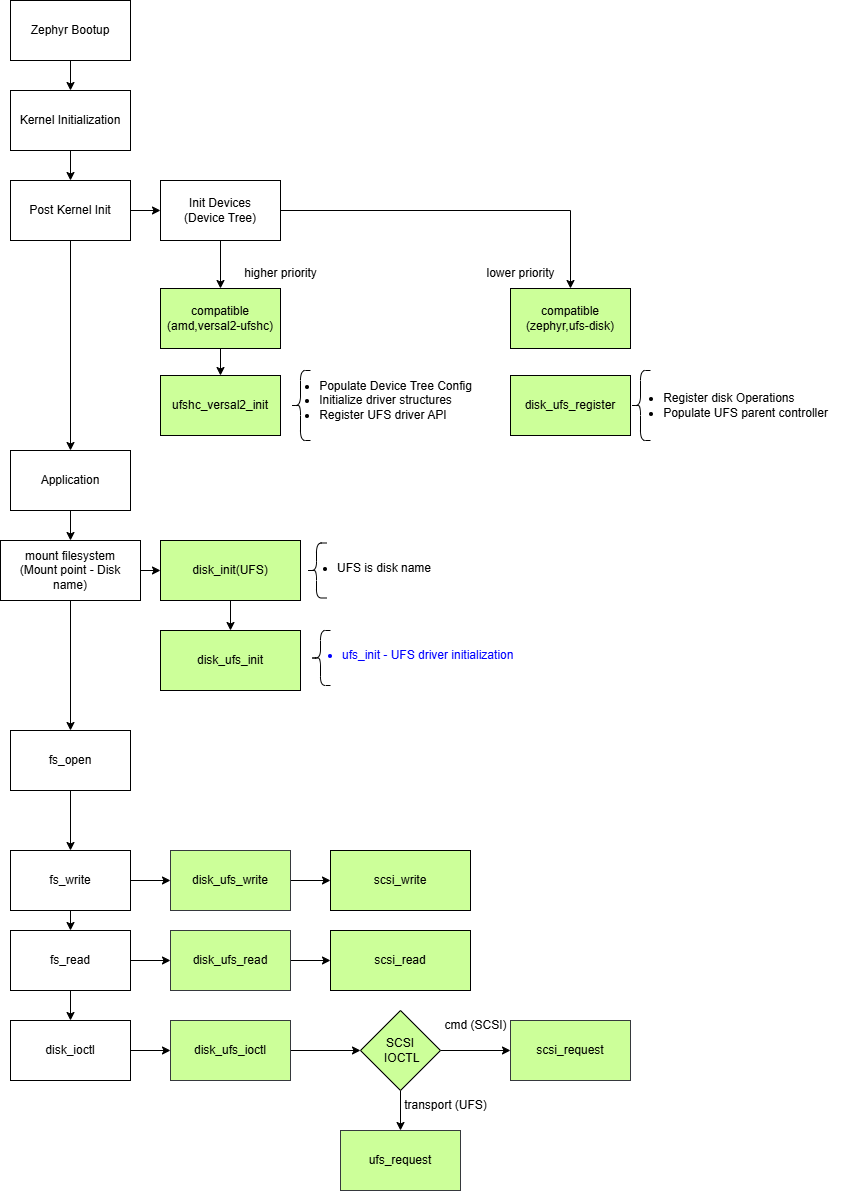
Zephyr - UFS Driver - Filesystem Example - Flow
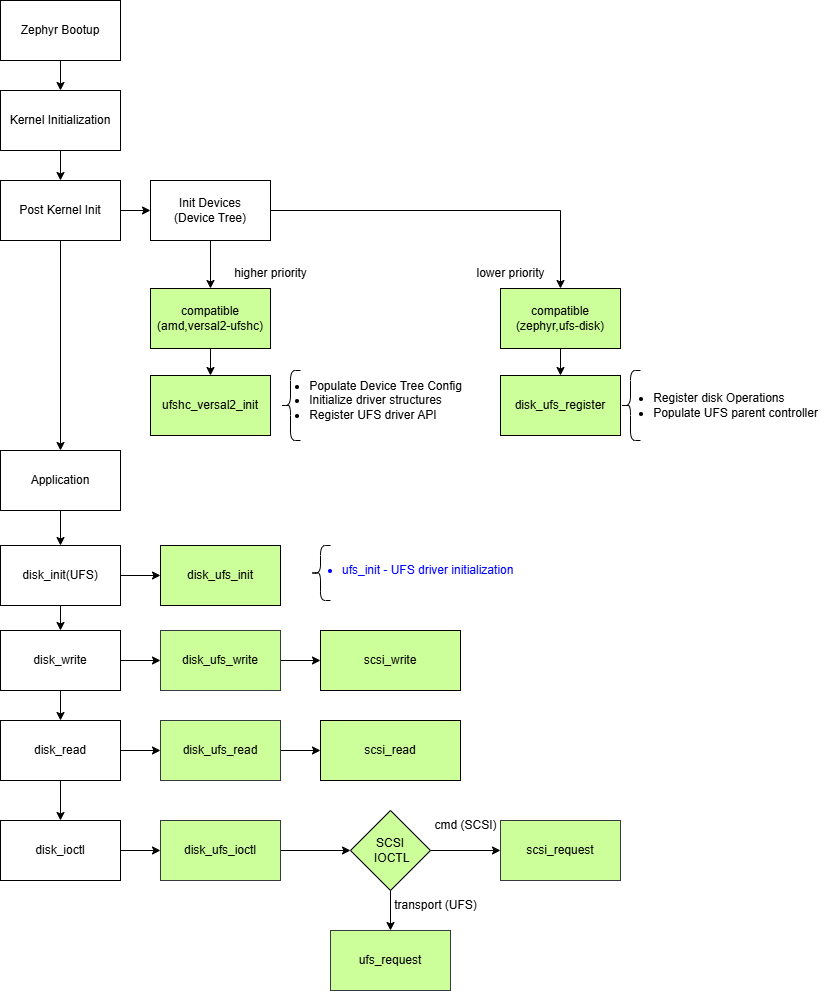
Zephyr - UFS Driver - Raw API Example - Flow
Zephyr - UFS Driver - Initialization Flow
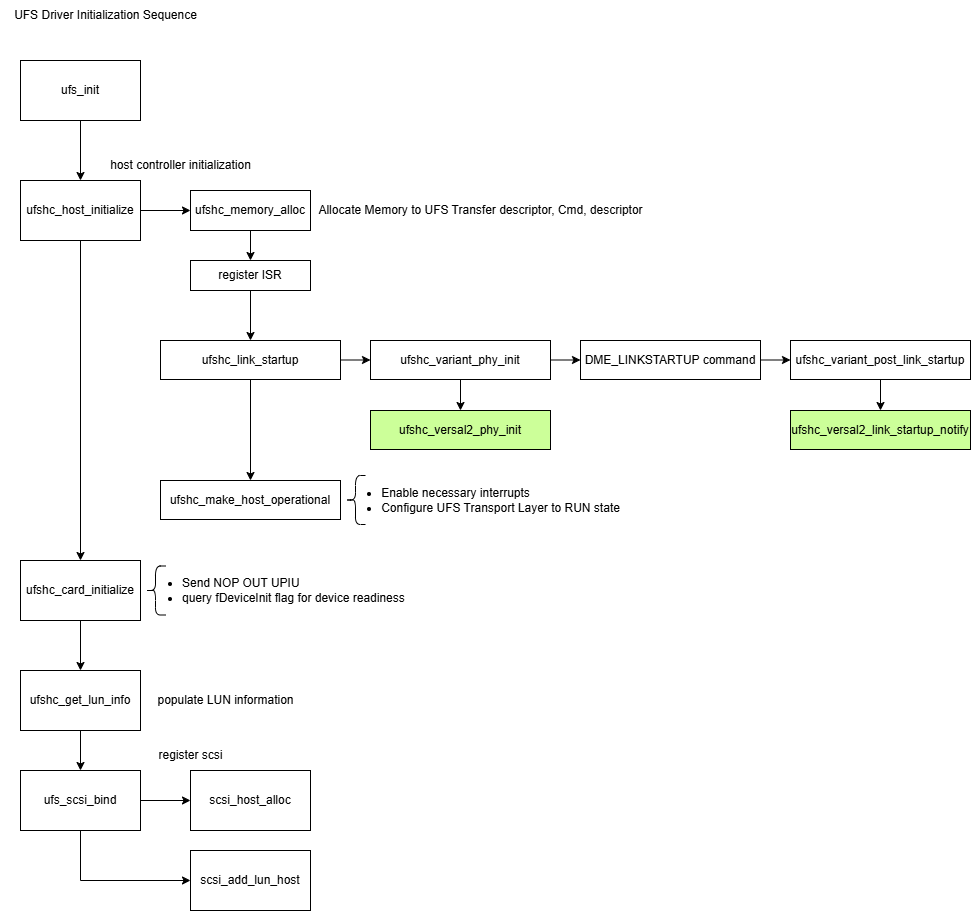
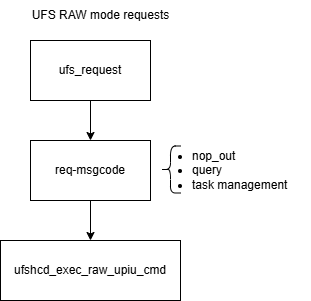
Zephyr - UFS Driver - RAW UFS requests